








“A lot of people don’t wake up one day and decide they’re no longer going to be active. It happens gradually,” said Maurice Tom-Pack, M.D., a board-certified orthopedic surgeon with Santa Rosa Medical Group. “They stop taking the long walk, they avoid the stairs, they don’t play golf as often or they find themselves sitting out activities with their family. Sometimes, those changes are the first indication that a joint problem is affecting their quality of life.”

Dr. Tom-Pack specializes in adult hip and knee reconstruction and sports medicine and brings more than 20 years of experience to his practice. He is the newest addition to the Orthopedics team at Santa Rosa Medical Group alongside Dr. Robert Dimick and Dr. Erwin Bennett.
When is pain more than just getting older?
Aches and stiffness can become more common with age, but persistent joint pain isn’t necessarily something people have to accept.
Pain that interferes with sleep, makes it difficult to walk or climb stairs, limits movement or keeps someone from participating in activities they enjoy may be a reason to seek an evaluation.
“Getting older doesn’t automatically mean you have to accept being in pain or becoming less mobile,” Dr. Tom-Pack said. “There are a lot of things we can do to help people stay active, and the right treatment depends on what’s causing the problem.”
An orthopedic evaluation doesn’t automatically mean surgery. Depending on the cause and severity of the problem, treatment may include physical therapy, medication, injections, activity modifications or other nonsurgical approaches.
“When someone comes to see me with hip or knee pain, surgery isn’t necessarily where the conversation starts,” Dr. Tom-Pack said. “We want to understand what’s causing the pain and look at the options that make sense for that individual.”
For some patients, however, arthritis or joint damage can eventually make everyday movement increasingly difficult. In those cases, hip or knee replacement may become an option.
 It’s about more than a joint
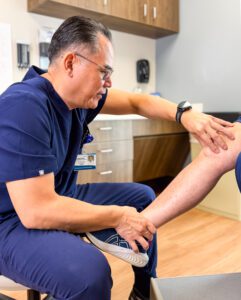 It’s about more than a joint
For many patients, joint replacement isn’t simply about treating a damaged joint. It’s about restoring the ability to participate in everyday life.
“The goal isn’t simply to treat a hip or knee. It’s to help people get back to doing the things that are important to them,” Dr. Tom-Pack said. “Whether that’s walking, working in the yard, traveling, playing with their grandchildren or getting back to a sport, mobility has a big impact on quality of life.”
Giving up one activity because of pain can seem insignificant. But over time, those small changes can add up, gradually limiting how someone lives.
That doesn’t mean every ache requires a specialist or that every patient with joint pain needs surgery. It does mean persistent pain deserves attention, particularly when it begins dictating what a person can and cannot do.
“I don’t want patients to think they have to give up the things they enjoy just because they’re getting older,” Dr. Tom-Pack said. “If pain is limiting you, it’s worth finding out why and seeing what options are available.”
Getting back to the activities you love starts with understanding what’s keeping you from them. To learn more or schedule a consultation with SRMG Orthopedics, call (850) 981-4008 or visit santarosamedicalgroup.com/orthopedics.